How do you plan power and wiring for motorized luxury theater recliners?
Every powered seat needs an outlet, a hidden cable route, and a place for its transformer. Plan it before the carpet goes down, not after the chairs arrive.
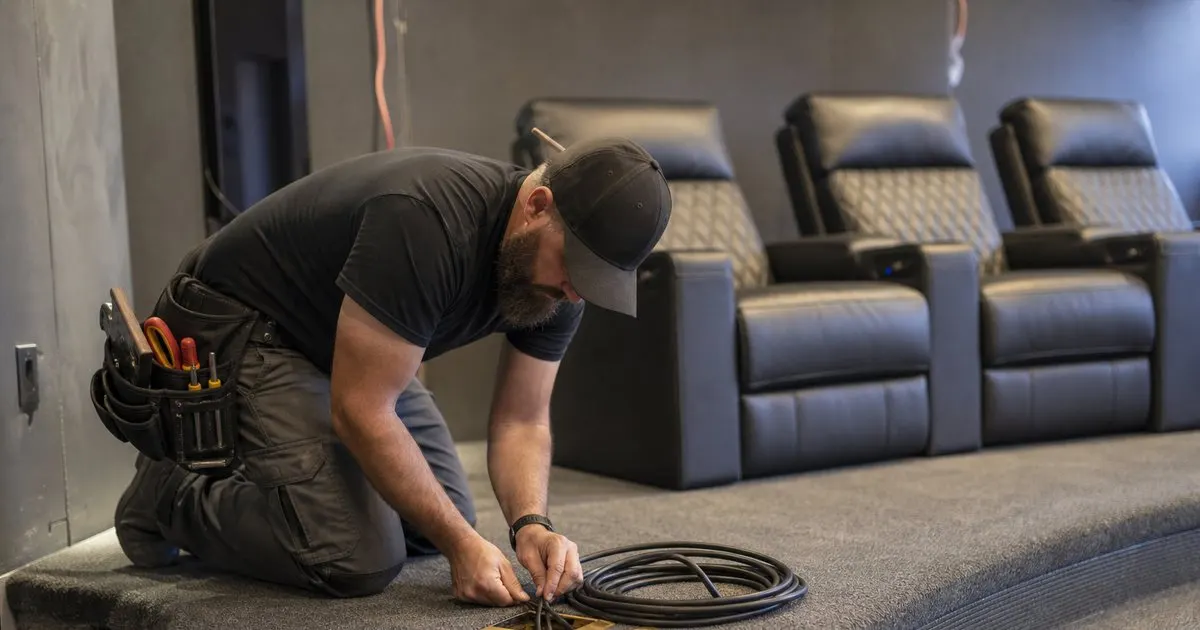
What each powered seat needs
A modern power recliner runs low-voltage motors fed by an external transformer that plugs into an ordinary household outlet, and the motors draw power only while the seat is moving. Options such as seat heating, massage, lighting, and USB charging add modest continuous loads. The exact draw varies by maker and configuration, so ask for the stated figure per seat and give it to your electrician rather than guessing. In most rows each seat has its own transformer tucked beneath the frame, though some collections chain several seats from a shared supply with a single cord to the wall. Related: Which reclining mechanisms deliver lasting comfort in premium theater seating arrangements at home?
Battery packs are available for seats that cannot reach an outlet, such as a loveseat floating in the middle of a media room on a concrete slab. They work well but need periodic recharging and add cost, so they are a fallback rather than a plan. Wherever possible, treat each seat position as a fixed appliance location and design a permanent, hidden power source for it, in the same way a kitchen island gets its own outlet before the countertop goes on. Related: What upholstery materials hold up best in a high-end private screening room over time?
Keep reading: How do you choose luxury home cinema seating for a dedicated theater room?, What upholstery materials hold up best in a high-end private screening room over time?, Which reclining mechanisms deliver lasting comfort in premium theater seating arrangements at home?. See how Plushseatr helps you a design guide to luxury home cinema seating.
Outlet placement: floor boxes, risers, and walls
The cleanest solution is a recessed floor outlet box directly beneath or just behind each seat, or one box per pair of seats, so that no cord ever crosses a walkway or shows beneath the row. On a riser this is simple: the electrician sets a listed floor box into the platform deck and runs conduit inside the cavity to a junction on the wall. On a slab or a finished floor with no platform, a wall outlet behind the row with cords routed under the chairs and a low-profile cord cover is the practical alternative, less elegant but serviceable.
Placement needs the chair's footprint drawing. A floor box under a moving part of the mechanism will be struck by the footrest linkage or the reclining back, and a box sitting where the transformer wants to live will fight for space with it. Ask the maker for dimensioned drawings of the chair in its upright and fully reclined positions, mark the transformer location, and set the boxes in the still zone beneath the seat. Do this before the deck is closed, because moving a floor box after carpet is a costly, visible repair.
Integration: lighting, control systems, and USB
Many luxury seats offer LED lighting along the base and inside the cup holders, and some can be tied into the room's control system so the seat lighting dims as the film starts. Integration methods vary from simple relay triggers to network control, and not every seat's electronics play well with every control platform, so bring the integrator into the conversation before ordering. USB and wireless charging ports built into the arms are convenient but draw from the same transformer, which is one more reason to know the seat's total load. Related: How do you choose luxury home cinema seating for a dedicated theater room?
Put the row on a switched, surge-protected circuit that the control system can power down with the room. It protects the electronics from surges, which most warranties exclude, and stops the small standby draw of a dozen transformers when the theater is idle. Keep every transformer reachable, ideally by lifting the chair skirt or opening a panel in the riser face, rather than sealed beneath the deck; a failed transformer is a common service call, and a technician should not have to lift carpet to reach it. Related: Why does row spacing matter so much when planning tiered home cinema seating?
Sequence, code, and the day the chairs arrive
Rough-in happens before drywall and before the riser deck is fastened. The electrician needs to know the number of seats, their positions, the box locations, and the total load, and the boxes must be listed for floor use and matched to the carpet and pad thickness so the covers sit flush. Floor boxes in a platform also need to remain accessible under local code, which usually means no permanent obstruction above them. Pull the required permit; a theater with hidden floor boxes is exactly the kind of work an inspector expects to see documented.
By delivery day every outlet should be live and tested. The installation team will assemble the row, plug in each transformer, clip the cords to the underside of the frames, and cycle every motor and feature while you watch. Ask them to leave enough slack that a chair can be pulled forward for cleaning without unplugging, and label the circuit at the panel. A few minutes of tidy cable management under the seats is the difference between a room that looks built-in and one that looks assembled.
- Plan one accessible outlet per powered seat, or per pair, located under the row so no cord crosses a walkway.
- Put recessed floor boxes in the riser deck and run conduit inside the platform before it is closed.
- Keep transformers reachable, add surge protection, and consider a switched circuit tied to the room control system.
- Get the chair's full-recline footprint and wiring diagram from the maker before the electrician roughs in.

Julien Jimenez
Julien Jimenez is an independent software builder based in Paris. He designs, ships, and operates focused SaaS products for small businesses and independent professionals. Read the full author page.
Seating Worthy of Every Screening
A design guide to luxury home cinema seating. Plushseatr is built to help you put this into practice.
Choose your seatingMore from the Plushseatr blog
How do you choose luxury home cinema seating for a dedicated theater room?
What upholstery materials hold up best in a high-end private screening room over time?
Which reclining mechanisms deliver lasting comfort in premium theater seating arrangements at home?
Get the complete luxury home cinema seating guide
Our full buying guide, the price guide, and new research as we publish it. One email, no spam, unsubscribe any time.