When should a front row use loveseats or chaises instead of individual recliners?
The seat you share on a film night is not the seat you choose for a screening with friends. Here is how to decide what belongs in the closest row.
How the front row is actually used
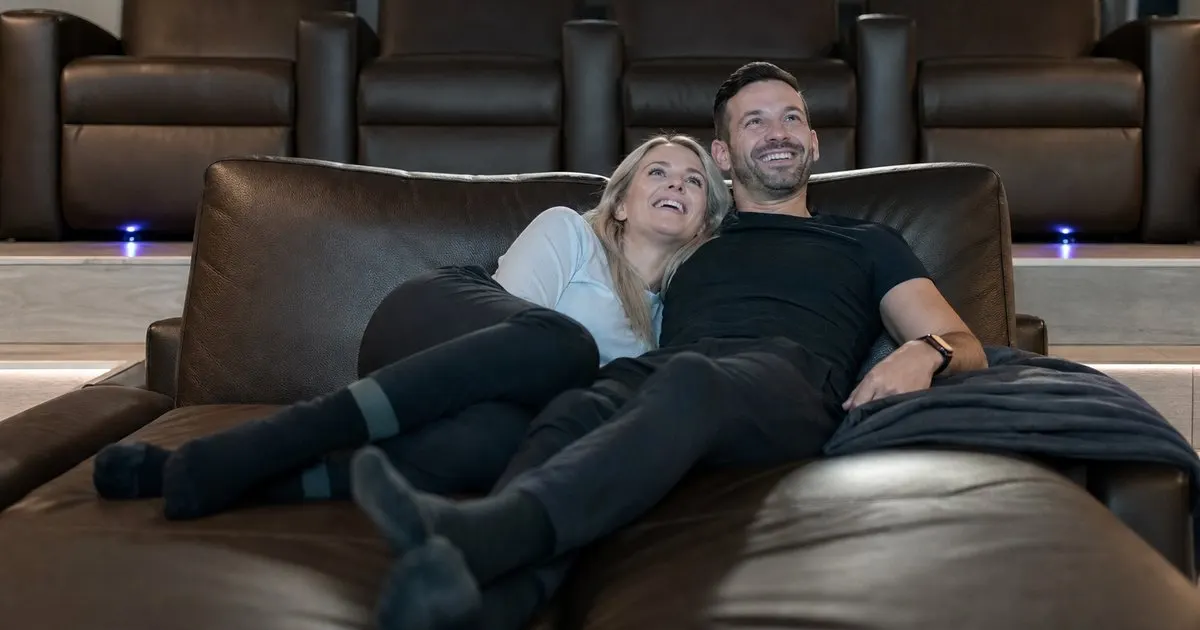
In most private theaters the front row belongs to the household. It is where the couple sits on an ordinary Tuesday, where children pile in with blankets, and where the dog ends up despite the rules. The rear row, on its platform, is where guests go when the room fills. Those two rows have different jobs, and it is worth designing them differently rather than repeating the same recliner across both. Start by counting evenings: if most viewings involve two people, the front row should be designed for two people first and for a crowd second.
Geometry matters here too. The front row sits closest to the screen, so its outer seats already look at the image from the widest angle. A wide loveseat centered on the screen keeps both of its occupants close to the center line, which is comfortable, while a chaise wide enough for two does the same with a lower profile. Individual recliners in a gently curved row also address this, but at the cost of the closeness a couple usually wants on a film night.
Keep reading: How do you choose luxury home cinema seating for a dedicated theater room?, What upholstery materials hold up best in a high-end private screening room over time?, Which reclining mechanisms deliver lasting comfort in premium theater seating arrangements at home?. See how Plushseatr helps you a design guide to luxury home cinema seating.
Loveseats: the shared arm question
A theater loveseat is two seats without the arm between them, usually with independent recline mechanisms for each side and either a single bench cushion or a split pair. The best versions include a fold-down center console with cup holders and a small storage well, so the piece becomes two proper theater seats when needed and one shared seat when not. Independent motors are essential; a loveseat where one side's recline moves the other is a compromise that grates quickly. Related: Which reclining mechanisms deliver lasting comfort in premium theater seating arrangements at home?
The trade-offs are subtle but real. Without a center arm, each occupant loses some lateral support and elbow room, and with a single bench cushion every shift of one partner is felt by the other. Split cushions and separate spring decks help, so ask how the seat is built beneath the cover. On the plus side, a loveseat is usually a little narrower than two arm chairs because it drops one arm, which can be the difference that lets a narrow room seat two in front and three behind. Related: How do you choose luxury home cinema seating for a dedicated theater room?
Chaises and lounge modules
A chaise module replaces the footrest mechanism with a long, continuous seat cushion that supports the whole leg, often paired with a powered back and headrest. It is the most comfortable thing in the room for lying down and the least suitable for sitting upright and attentive through a long film, and it is harder to rise from than a chair with arms. Double-width chaises and daybed-style pieces have become fashionable in luxury rooms, typically as a front row for the household with a platform of recliners behind for guests.
Chaises change the room's geometry in two useful ways. Their backs are usually lower than a full recliner's, so the rear row needs less riser height to see over them. Their length, however, is considerable, and a chaise row takes noticeably more depth than a recliner row in the upright position, which can push the rear platform back toward the wall. Check the depth of the exact module against the floor plan before assuming it will fit where a row of chairs was drawn. Related: Why does row spacing matter so much when planning tiered home cinema seating?
Deciding, and mixing pieces in one room
The decision usually resolves along a few lines. A couple who hosts occasionally does well with a loveseat in front and recliners behind. A family with young children often prefers a chaise or lounge module in front, where everyone can sprawl. A household that runs frequent screenings for friends, or that values long, attentive viewing over lounging, is better served by individual recliners in both rows, perhaps with one loveseat at the center of the front row as a nod to the hosts. Individual chairs also remain the most flexible if the room is ever reconfigured or the house is sold. Related: What upholstery materials hold up best in a high-end private screening room over time?
Whatever the mix, keep it within one collection so the arm profiles, stitching, mechanism silhouettes, and cover match across rows, and order every piece at once so the leather comes from a single dye lot. Mixing a loveseat from one maker with recliners from another rarely looks intentional. This guide is independent and may earn a commission on some links; that does not change the advice, which is to design the front row around the people who sit there most and let the rear row take care of the crowd.
- Build the front row for the number of people who actually use it most nights, which is often two.
- A loveseat with independent mechanisms and split cushions gives couples closeness without transferring every movement.
- A chaise or lounge module is best for lying down and keeps the back low enough to shrink the rear riser.
- Order every row from one collection and one dye lot so mixed pieces read as a single design.

Julien Jimenez
Julien Jimenez is an independent software builder based in Paris. He designs, ships, and operates focused SaaS products for small businesses and independent professionals. Read the full author page.
Seating Worthy of Every Screening
A design guide to luxury home cinema seating. Plushseatr is built to help you put this into practice.
Choose your seatingMore from the Plushseatr blog
How do you choose luxury home cinema seating for a dedicated theater room?
What upholstery materials hold up best in a high-end private screening room over time?
Which reclining mechanisms deliver lasting comfort in premium theater seating arrangements at home?
Get the complete luxury home cinema seating guide
Our full buying guide, the price guide, and new research as we publish it. One email, no spam, unsubscribe any time.