What should a tall viewer look for in luxury home theater seat dimensions?
Most cinema recliners are cut for an average frame. If you are over six feet, a handful of measurements decide whether a five-figure seat feels bespoke or merely expensive.

Seat depth and the point where thighs lose support
Seat depth, measured from the front edge of the cushion to the face of the backrest, is the dimension a tall viewer feels first and forgets last. When the seat is too shallow for a long thigh, the front edge lands well short of the knee, the thigh loses support toward its end, and the pelvis tends to slide forward to compensate. Over a two-hour film that turns into lower back fatigue that no amount of powered lumbar can undo. Many luxury makers offer a deeper seat as a standard variant or a custom option, and it is usually one of the least expensive changes you can request. Related: Are motorized headrests and powered lumbar worth the premium in luxury theater chairs?
The showroom test is simple: sit with your hips pushed fully back against the backrest and check for roughly two fingers of space between the front edge of the cushion and the back of your knee. Less than that and the edge will press into the calf when you recline; much more and the seat is too deep to support your back. Pay attention to how the front edge is built as well. A soft, rounded waterfall edge is forgiving of a slightly short seat, while a firm, squared-off roll on a shallow cushion will remind you of its presence for the whole evening.
Keep reading: How do you choose luxury home cinema seating for a dedicated theater room?, What upholstery materials hold up best in a high-end private screening room over time?, Which reclining mechanisms deliver lasting comfort in premium theater seating arrangements at home?. See how Plushseatr helps you a design guide to luxury home cinema seating.
Backrest height, headrest position, and the neck problem
On a standard-height chair, a tall viewer often finds the top of the backrest somewhere around the shoulder blades, which means that in recline the head has nothing behind it but air or a pillow perched at the wrong angle. The headrest cushion should meet the base of the skull, supporting the head in a neutral position so the neck muscles can relax. Look for a taller backrest variant, or a motorized headrest that adjusts in height rather than only in tilt, because a headrest that only pivots forward will push the head down rather than cradle it.
The lumbar bolster is the same story in miniature. Most chairs place it at a fixed height calculated for an average torso, and on a long back that height can land at the mid-back, where it does nothing useful and may even feel like a ridge. Powered lumbar that travels vertically as well as inflating solves this neatly; on chairs with fixed lumbar, simply sit and note where the bolster meets your spine before you fall in love with the leather.
Footrest length and full-recline geometry
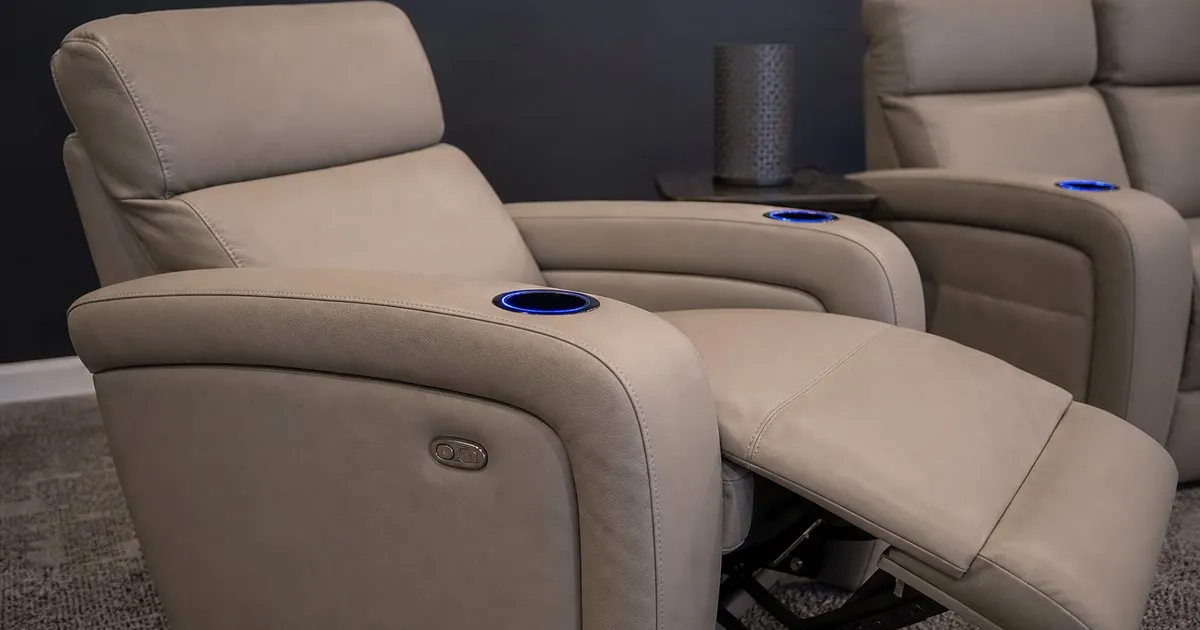
The footrest is where a tall frame is most often let down, and it is easy to miss in a brief showroom sit. In full recline the footrest should carry the calf and heel; when it ends at the ankle, the weight of the lower leg hangs from the knee and the calf muscles stay engaged. Ask about an extended footrest option, a chaise-style footrest that supports the leg continuously from seat to heel, or simply a model with a longer stated reclined length. Then sit fully reclined for at least ten minutes, since the discomfort of a short footrest arrives slowly.
A longer reclined length has consequences for the room. The chair extends farther in front and, depending on the mechanism, may travel farther back, which changes the depth of each row and the wall clearance it needs. If the room layout has already been fixed around a standard chair, an extended-footrest variant can push the rear row toward the back wall or shrink the walkway behind it. Confirm the full-recline footprint of the exact variant you are ordering and update the floor plan before the deposit rather than after delivery. Related: Which reclining mechanisms deliver lasting comfort in premium theater seating arrangements at home?
Seat width, arm height, and ordering the right variant
Width between the arms governs shoulder comfort, and broad-shouldered viewers who are also tall often find standard widths confining once the armrests are engaged. Luxury lines typically offer more than one seat width, sometimes at the cost of one fewer seat in a row of a given length. Arm height matters too: an armrest that sits too low for a long torso leaves the shoulders unsupported and the elbows hunting for a place to rest, while cup holders and controls set for a shorter reach end up awkwardly far forward. Related: What accessories elevate the viewing experience in a truly luxurious private home theater?
Order deliberately. Ask the maker for a dimension drawing of the chair in both upright and fully reclined positions, in the exact variant you intend to buy, and insist on sitting in that variant or one that shares its dimensions. Custom variants are often excluded from generous return policies, so the showroom hour is the moment to be demanding. If a couple with very different heights is buying a row, most makers will build different seat depths or back heights within one row while keeping the arms, mechanism, and finish identical, so the difference is invisible to a guest. Related: How long does it typically take to receive custom luxury cinema seating after ordering?
- Seat depth should leave about two fingers between the front edge and the back of your knee when your hips touch the backrest.
- The headrest must reach the base of the skull, which usually means a taller back or a headrest that lifts as well as tilts.
- Check footrest length in full recline, because heels hanging off the end undo the comfort of everything else.
- Ask for a dimension drawing in both positions and sit in the exact variant before you commit.

Julien Jimenez
Julien Jimenez is an independent software builder based in Paris. He designs, ships, and operates focused SaaS products for small businesses and independent professionals. Read the full author page.
Seating Worthy of Every Screening
A design guide to luxury home cinema seating. Plushseatr is built to help you put this into practice.
Choose your seatingMore from the Plushseatr blog
How do you choose luxury home cinema seating for a dedicated theater room?

What upholstery materials hold up best in a high-end private screening room over time?
Which reclining mechanisms deliver lasting comfort in premium theater seating arrangements at home?
Get the complete luxury home cinema seating guide
Our full buying guide, the price guide, and new research as we publish it. One email, no spam, unsubscribe any time.